

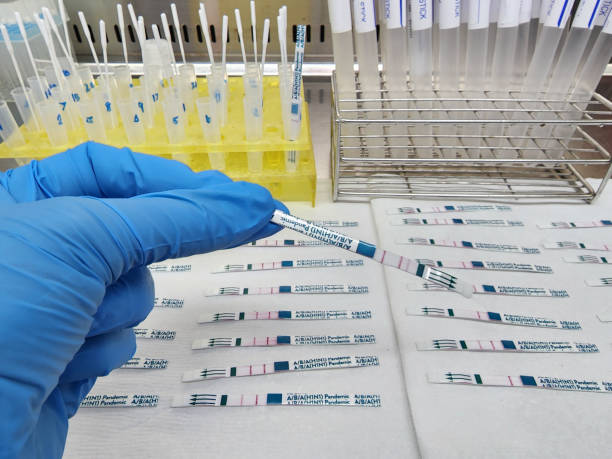
Quick Answer
Quick Answer: Fentanyl test strips are immunoassay-based strips that detect the presence of fentanyl and many fentanyl analogs in drugs or residue. Studies show they reduce overdose risk and have prompted behavioral changes in the majority of users who test positive. They aren’t perfect, but they’re the most accessible fentanyl screening tool currently available.
What Are Fentanyl Test Strips and How Do They Work?
Fentanyl test strips are small lateral-flow immunoassay strips, similar in technology to at-home pregnancy tests. They were originally designed to detect fentanyl in urine for drug monitoring programs. Harm reduction organizations figured out that dissolving a small amount of drug residue in water and dipping the strip gives a usable positive or negative result for fentanyl contamination.
The strip result is read in two to five minutes. One line means fentanyl detected. Two lines means not detected. It’s the same logic as most rapid diagnostic tests, which trips people up at first.
Accuracy varies by substance type. A 2019 study published in the International Journal of Drug Policy found fentanyl test strips correctly identified fentanyl in drug samples with a sensitivity of around 96% and a specificity of 100% when used with heroin. Results are slightly less reliable with methamphetamine due to matrix interference, but still well above chance.
Do Fentanyl Test Strips Actually Change Behavior?
This is the question skeptics raise first. And the data is actually pretty compelling.
A 2021 study from Brown University School of Public Health followed people who used fentanyl test strips and found that 72% of participants who got a positive result changed their behavior in response: using less, using slower, using with others present, or not using the substance at all. That’s not a marginal effect. That’s most people making a safety decision they couldn’t have made without the test.
The challenge is access. Until recently, many US states classified fentanyl test strips as drug paraphernalia, making legal distribution complicated. That’s changing quickly. As of 2024, the majority of US states have passed legislation explicitly exempting fentanyl test strips from paraphernalia laws.
What Can Fentanyl Test Strips Detect?
Standard fentanyl test strips detect fentanyl and most common fentanyl analogs, including acetylfentanyl, butyrfentanyl, and furanylfentanyl. They do not reliably detect carfentanil or nitazenes, which are newer synthetic opioids now appearing in the drug supply.
That’s a real limitation worth stating clearly. A negative strip result reduces risk, it doesn’t eliminate it. Newer synthetic opioids are outpacing the detection capabilities of existing test strips, which is why full fentanyl test kits with broader screening panels are worth considering in high-risk environments.
How Do You Use Fentanyl Test Strips Correctly?
- Dissolve a small amount of drug residue (or the rinse from a used bag or cooker) in water. For MDMA or methamphetamine, use at least a quarter teaspoon of water per small sample to dilute the matrix interference.
- Dip the strip wavy-end down for about 15 seconds.
- Lay it flat and read the result at two to five minutes.
- One line in the C region only means fentanyl detected. Two lines (C and T) means not detected.
- Never read results after 10 minutes, the test window closes and results become unreliable.
Are Fentanyl Test Strips Enough on Their Own?
No, and it’s important to say that without qualification. Fentanyl test strips are one layer of risk reduction. They work best when used alongside other practices: never using alone, having naloxone available, starting with a small test dose if using at all, and having someone present who knows what to do in an overdose.
Harm reduction isn’t a single tool. It’s a set of decisions that compound. Test strips are often the lowest barrier entry point because they’re cheap, discreet, and fast.
Frequently Asked Questions
Frequently Asked Questions
Q: What are fentanyl test strips made from?
A: They’re lateral-flow immunoassay strips that use antibodies specific to fentanyl. When fentanyl is present, it blocks the antibody reaction, resulting in one visible line instead of two.
Q: How accurate are fentanyl test strips?
A: Studies report sensitivity rates of 93 to 100% depending on the substance being tested. They are most accurate with heroin and slightly less reliable with meth or cocaine due to matrix effects.
Q: Where can I get fentanyl test strips?
A: Many harm reduction organizations distribute them for free. They’re available online through harm reduction suppliers and increasingly through pharmacies in states that have removed paraphernalia restrictions.
Q: Can fentanyl test strips detect all fentanyl analogs?
A: Most common analogs, yes. Carfentanil and newer synthetic opioids like nitazenes are often not detected. Always treat a negative result as risk-reduced, not risk-free.
Q: Are fentanyl test strips legal?
A: Legality varies by US state, though most have now exempted them from paraphernalia laws. They are legal for purchase and distribution in Canada, the UK, and most of Europe.